Welcome to the Arctic Genomics Knowledge Mobilization platform — an online knowledge sharing hub for Indigenous communities and broad Canadian and Arctic-wide partners to find relevant wildlife genomics information for environmental decision making.
Explore the landing page to learn more about wildlife genomics and what it means to our Inuit partners living in Nunavut. Access the search and database catalog, organized around specific species to deliver information on how to implement genomics science in conservation settings through co-learning with community based monitoring projects and their processes, as well as links to access the wildlife genomics data.
With language and genomics concepts translation pages also available, the suite of genomics knowledge mobilization tools, co-created together with expert partners across disciplines, cultures, and organizations, has been designed as a critical warehouse of information for diverse communities of stewardship and conservation.
Click the “Join us” link below to participate in the community of practice to share with others and meet the challenges of new and emerging health risks, specifically pathogenic threats to the wildlife species of concern and of cultural importance.
Use the Arctic Genomics Knowledge Mobilization platform to discover the wildlife genomics science and Inuinnait knowledge employed in the community of Cambridge Bay, Nunavut, and communities beyond. You can also learn about genomics and community based monitoring, and perform an information search.
Preview the platform's Language Translator and About Co-development pages below.
Access the 100+ co-developed translations from genomics science into Inuinnaqtun, some of them newly created terms. The Arctic Genomics team has been working with Inuit partners in Cambridge Bay to make useful linkages between new and existing Inuinnaqtun terms and the genomics world to support informed decisions and so that this information can be made and accessible to those outside of these collaborative efforts and programs.
Learn more about the co-development process and meet our partners! The knowledge mobilization platform, the database collection, and the presentation of Inuktut languages have been guided by our partners and Inuit Qaujimajatuqangit (IQ) principles.
The flying formation of the Kaaraq (Nerlernaq/Canada Goose) represents when we work together across different cultures, languages, and knowledge systems. “We are the geese, flying in formation together toward shared goals”, as noted by Emily Angulalik. She goes on to describe how the Cambridge Bay Inuit Elders have guided that “when guiding principles about animals and the Inuit Nunangat environment are at stake, Inuit must lead at the front of the formation.”
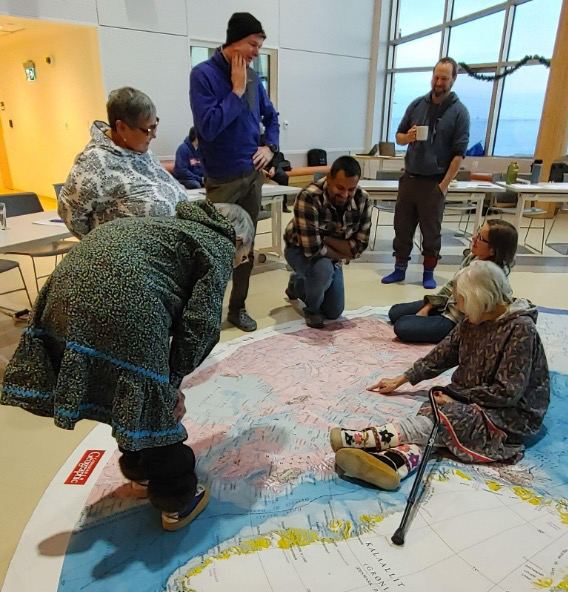
Pictured here: Inuit KHS Elders-In-Residence teach members of the Arctic Genomics team and other workshop participants about traditional knowledge as tied to territory. From left to right: Mabel Etegik, Emily Angulalik, McCaide Wooten, Srijak Bhatnagar, Steve Crookes, Susan Kutz, and Bessie Omilgoetok. Location: Cambridge Bay, NU, Canadian High Arctic Research Centre (CHARS). Photo credit: Christy Caudill
© Arctic Institute of North America, University of Calgary
Site & Image Information