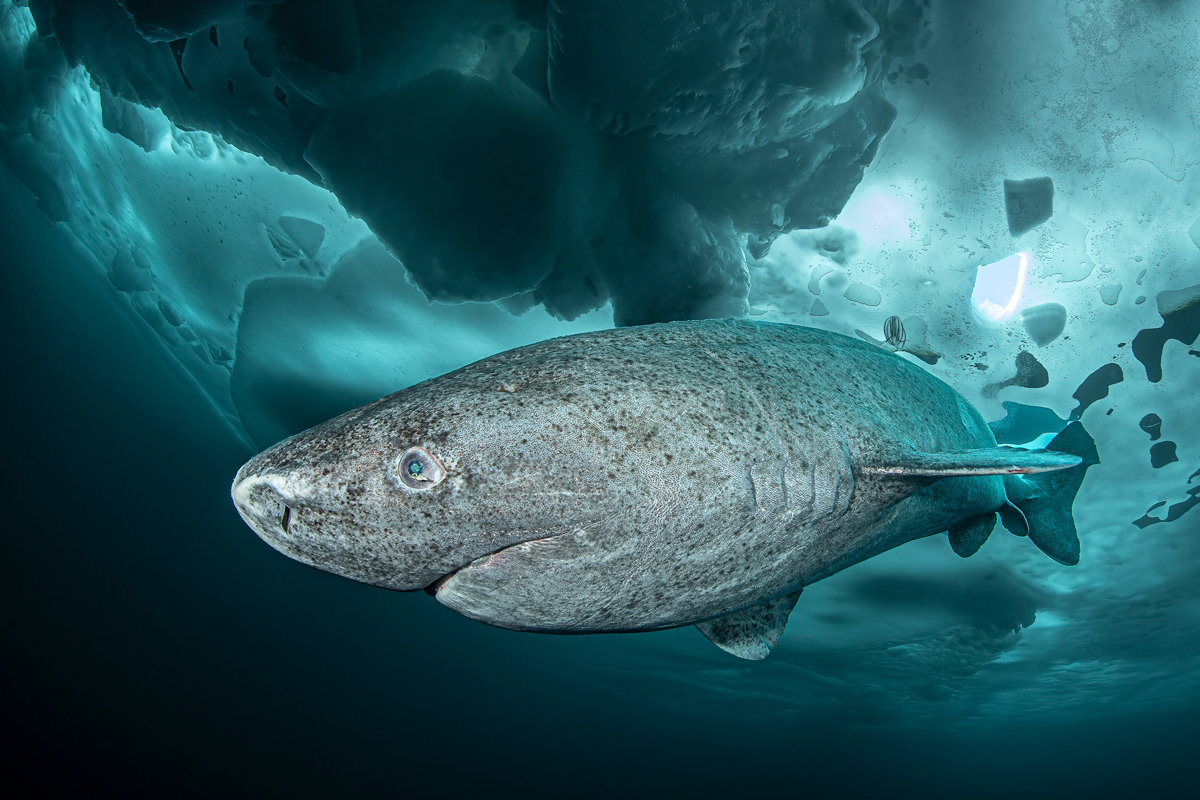
Photo by Lars von Ritter Zahony / Ocean Image Bank.
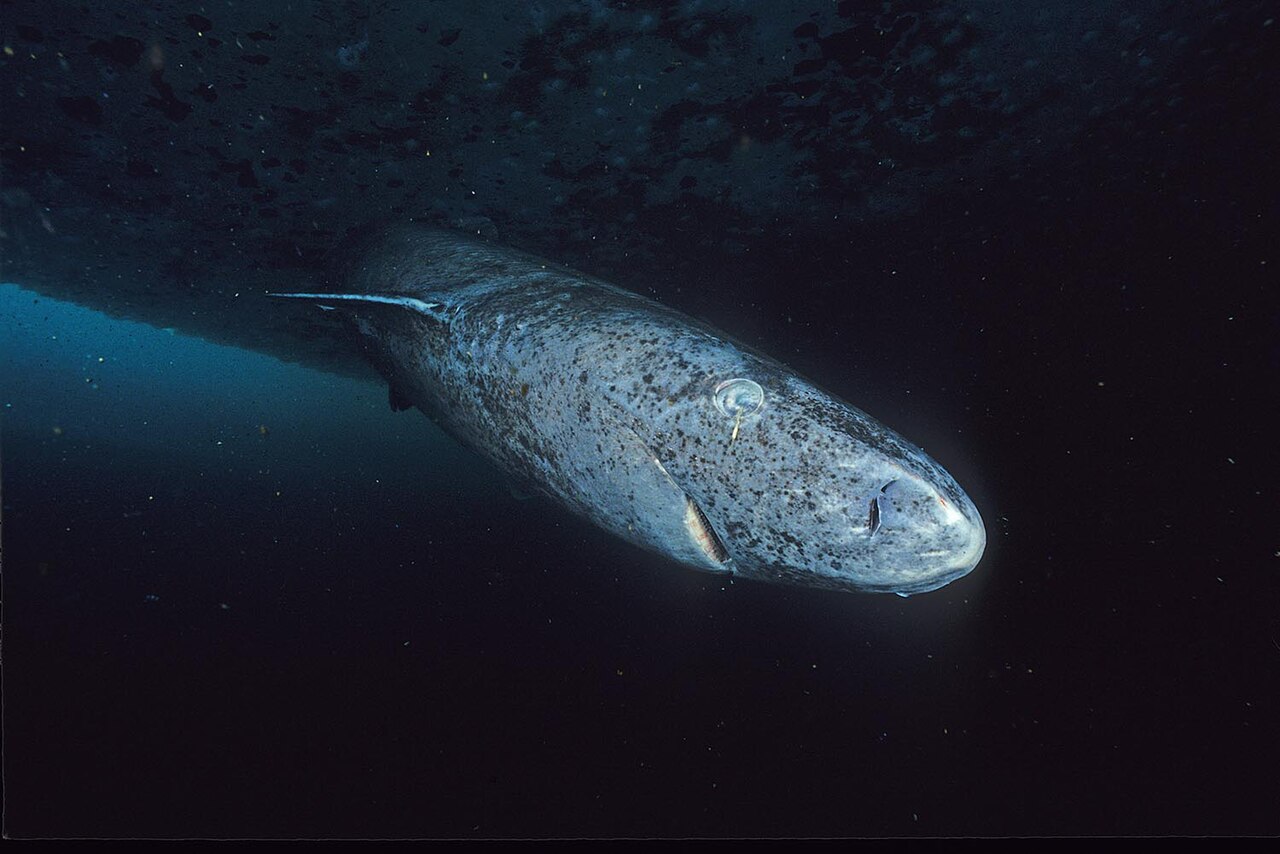
Photo by Hemming 1952, some rights reserved (CC BY-SA 4.0).
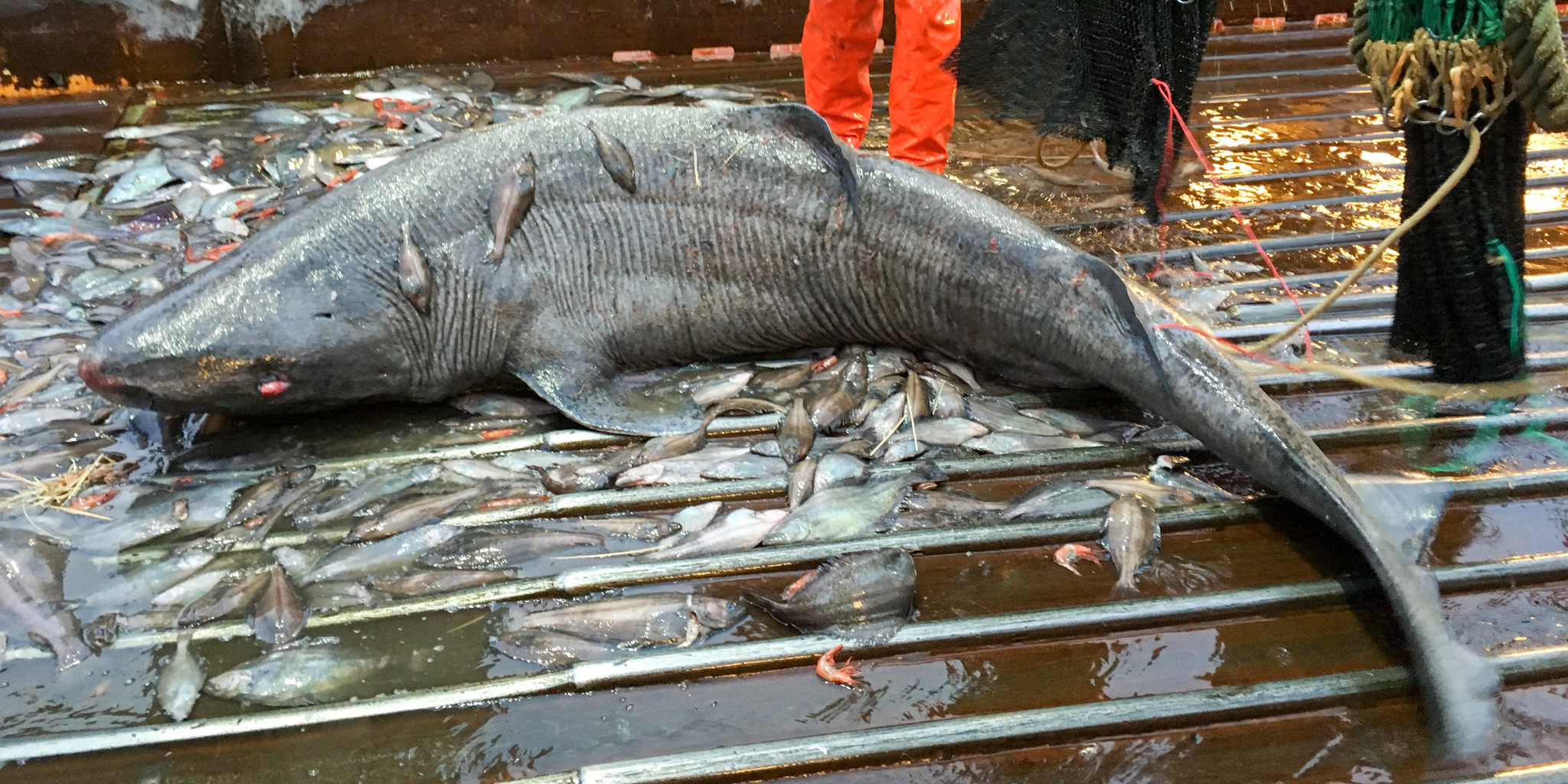
Photo by Claude Nozères, some rights reserved (CC BY-NC).
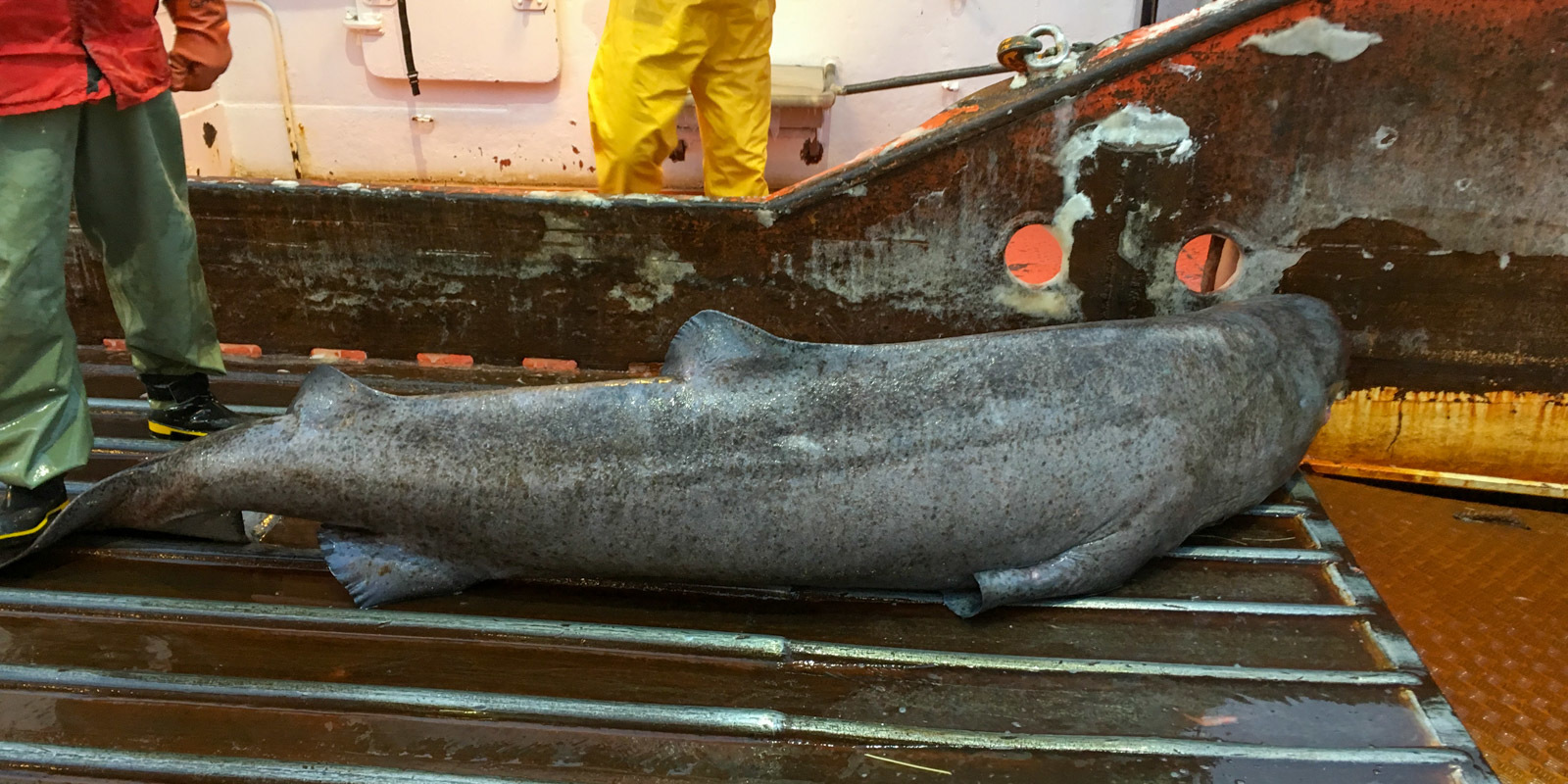
Photo by Claude Nozères, some rights reserved (CC BY-NC).
Somniosus microcephalus
Vulnerable (IUCN; assessed June 20, 2019; population trend, decreasing).
Deepwater sharks lead a mysterious life that has taxed the most resourceful of biologists. The Greenland shark is no exception. However, with the advancement of sophisticated technologies – including population genetics and genomics methods - light is now being shone on the murky world of the giant Eqalussuaq of the Arctic deep.
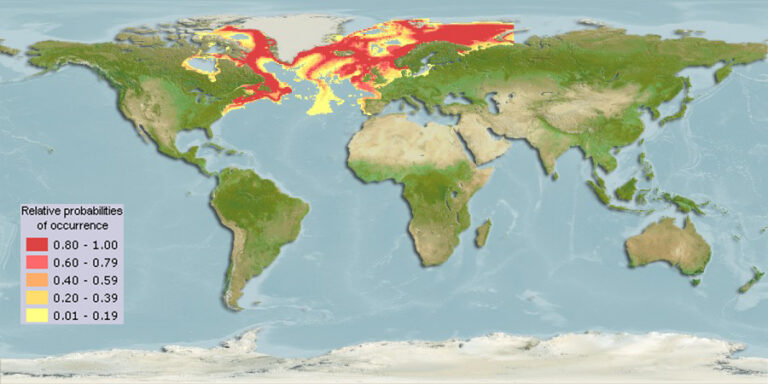
Greenland sharks are found in deep waters of the North Atlantic and Arctic Oceans (see map), although it has also been found in the deep waters of the Gulf of Mexico and the Caribbean. Where – and for how long, and for what biological purposes - Greenland sharks go is currently under scrutiny. However, the presence of juvenile Greenland sharks in Canadian Arctic waters suggest that Greenland sharks may prefer cooler waters for nursery areas. Sharks may surface and move to shallow coastal waters if feeding opportunity (e.g., presence of whale offal) presents itself and if the inland region is relatively ice-free. Tagging studies confirm that Greenland sharks are highly mobile and may swim vast distances over a relatively short period of time (e.g., 1615 km over 170 days in Cumberland Sound, Nunavut), and between different nation-state territorial waters (e.g., between Canada, USA and Greenland). These migrations appear to be seasonal, with Arctic waters and coastal waters visited in late Summer/Fall, and deeper more, southerly waters, over Winter.
Greenland sharks are ovoviviparous, in that eggs develop but then hatch within the female shark’s uterus. The young embryonic sharks then continue to develop through imbibing of a nutrient-rich yolk (lecithotrophic viviparity), after which they are born. As noted, development is extremely slow and sexual maturation is not reached, at least for females, until a sesquicentenary of their birth has passed. However, observing a pregnant female is very rare and, as of 2026, only two have ever been recorded, including one female carrying 10 pups, each of which were close to term. Comparative energetic studies of other sharks suggests that the maximum number of embryos (called a ‘litter’) a Greenland shark may carry to term may be around 22 for a large, 5m shark. Generation time (time from egg fertilisation to delivery of a litter) is currently unknown, but in other sharks this may be as long as two years. The sexual act of the coupling of males and females has not yet been observed, but since this likely takes place at depth, is not surprising. Whether the act of coupling is an opportunistic, on-the-fly, event, or takes place at specific locations with groups of sharks migrating there for that specific purpose, is also unknown. Knowledge of key elements of reproductive biology are essential for effective management strategies.
The Inuktitut names for the Greenland shark (e.g., Iqalukjuaq ) translate into English as ‘big fish’. Due to this species moving into the coastal shores of the Arctic archipelago during the summer months, Inuit have encountered Iqalukjuaq on a regular basis through sightings, catches and corpses washing up on the shoreline. Accordingly, this behemoth has influenced Inuit culture, including playing a role in creation stories, as well as establishing a rich traditional ecological knowledge source for this species. The legend of Sedna – the Inuit Goddess of the Sea – is a rich, complex tale of Sedna, who hitherto becoming the Goddess of the Sea, was the victim of deception by a proposed husband and, eventually, by her own father who threw her overboard when they were escaping the husband (a raven in disguise) to save his own skin. In an attempt to save herself, Sedna clung to the boat, but her father chopped off her fingers and hands, which transmogrified into the fishes and marine mammals that we see today. Sedna settled to the bottom of the sea whereupon she ascended to Goddess status and influences, to this day, the luck of Inuit hunters in harvesting from the sea. Iqalukjuaq, according to this story, are derived from the disembodied digits and hands of Sedna, as part of the bounteous diversity of the sea. More specifically, the Greenland shark itself has its own origin story, the Tale of the Skalugsuak. In this retelling, the traditional practice of washing hair in urine plays a significant role explaining the strong urine smell of the shark. In the past, an old woman washed her hair in the traditional way, using a cloth soaked in urine (for the cleansing properties of urine). However, upon a strong gust of air, the cloth blows away and alights in the sea. This cloth becomes the Skalugsuak, the first Greenland shark. For devotees of Sedna, the urine smell of the shark is derived from their living in ‘Sedna’s Urine Pot’, imbuing the shark with its characteristic urine smell, as well as spiritual connectivity to Sedna herself. For Greenlandic Inuit, the shark is associated with the story of the “Old Woman of the Sea” (Arnakuagsak), similar to Sedna, embodying the unworldliness of the marine realm as conveyors of spirituality, connecting Inuit with the deep.
Highly secretive or remote animals are difficult to study - especially so in the past - thus determinations of abundances and distributions from modern, technologically advanced, methods have had to rely on highly destructive historical processes (e.g., commercial fishing of sharks for their oil-rich livers, for example) for comparisons from which to contextualize modern population estimates and infer population trends. The IUCN lists the Greenland shark as vulnerable, using criteria A2bd, which states that populations are known to have decreased over a specific timeframe, for at least 10 years, and as a result of known causes of exploitation. Historically, the Greenland shark has been exploited for its oily livers since the 13th century, ramping up in the 19th and 20th centuries due to changes in commercial fishing practices. Only relatively recently (1940s-60s), has exploitation on such a scale been curtailed due to the manufacturing of cheaper, more accessible synthetic oils; although significant numbers (3500 globally) continue to be caught as bycatch. In Canada, the Committee for the Status of Endangered Wildlife in Canada (COSEWIC), in its 2025 report, lists this species as “Special Concern”. Ongoing and future potential threats to this shark in Canadian waters, as reported by COSEWIC, centre around the direct and indirect impacts of climate change. Warming oceans may decrease the availability of cold waters that this species prefers, whilst also increasing the northward incursion of other warmer-water loving species and their associated fishing industries. Thus, there are anticipated negative effects of warming oceans on habitat availability, physiology, behaviour (including reproductive biology), phenology (timing of migrations, for example), and fishery-associated bycatch mortality.
Moreover, epistemologically, relatively little knowledge is available to us in regard to certain aspects of the shark’s ecology, including general movements, reproductive biology, and habitat use. However, we do know that sexual maturity of females takes almost several human lifetimes to achieve, thus placing a limit on the rate that a population may recover if it experiences a sizeable loss of breeding individuals. Learning more about the basic biology and ecology of this vast chondrichthyan (cartilaginous fishes – sharks, rays, ratfish, etc) will provide us with a much firmer footing upon which to build effective conservation and management practices. It is possible that this species, being a top predator, inhabiting regions of the ocean in which it could live in relative harmony (at least until humans came along with industrialized commercial fishing equipment)) enjoyed large numbers in the past, including high levels of genetic diversity. This is something that is eminently testable using modern genomics methods (see below) and may reveal how rapidly levels of within-species genetic diversity is being eroded, and even if this has immediate impacts on population or species health. Molecular ecology may provide immediate insights whilst non-molecular ecological monitoring methods continue to generate important novel data regards contemporary aspects of the Greenland shark’s behaviour, migratory movements, reproductive biology, and habitat use.
Like many sharks, there is a great deal that we do not know about the Greenland shark’s basic biology. Pursuing them at depths is technically difficult and expensive. Genomes, however, may shed some light on this denizen of the dark, revealing some of the evolutionary, adaptive, or ecological traits that make this species so fascinating and a perfect predator of Arctic marine waters.
One of the more basic observations that scientists once made about Greenland shark biology concerned eyesight. The sharks have cloudy, seemingly useless, eyes beset by parasites. This led to the, now outmoded, suggestion that Greenland sharks were blind; the perception being that they did not need their eyes because of how little light is available at great depths. However, Greenland sharks do not stay at in the deep all of the time. Recent work on gene activity from a reading of genome function suggests that this is not actually the case. Most genes are read by cellular machinery and transcribed into a suite of intermediary molecules called RNA. A vast subset of these RNA molecules (messenger RNA or mRNA) is then translated into proteins which make up the bulwark of the active building blocks, or agents of biochemical processes (such as enzymes), that work together to make cells function, grow, divide into tissues and organs, and produce living organisms. By looking at which genes are active or not (e.g., turned on, off, up or down) by sequencing the entire suite of mRNAs in a particular tissue type (e.g., eyes) using the same technology to read entire DNA genomes (but here we extract total RNA and, using a bit of molecular magic, turn it back into DNA using a reversal of the process of transcription (literally called ‘reverse transcription’) that originally produces the RNA in cells. This total ‘complementary DNA’ or ‘cDNA’ is then sequenced using modern sequencing technology). This reading of the products of transcription is called ‘transcriptomics’ (the genomics of transcripts, in essence). By peering into the genomics of transcription in Greenland shark’s retinas, and by analyzing whole genomes of the Greenland shark, researchers discovered that the shark has a suite of well-maintained genes – and their RNAs - that encode for proteins associated with dim-light vision (proteins that work in cells called ‘rods’ embedded in the retina). Conversely, genes associated with brightness (and color vision in mammalian eyes) have begun to evolutionarily degrade. This suggests that eyesight in these sharks is specialized for low-light conditions, emblematic of the deep waters in which they spend most of their time.
In a paper published online in 2025, Yang and colleagues unveiled a chromosomal-level whole genome analysis of the Greenland shark. This study not only provided independent evidence for the low-light vision capabilities as discussed in the previous study (supporting the ‘blue-shift’ capabilities for low-light vision in genes associated with the biological apparatus of retinal function) but provided insight into levels of historical trends of genomic variation within the species as a whole. Comparing the Greenland shark with its congeneric species the Pacific sleeper shark (S. pacificus), the researchers inferred that both species have undergone an historical erosion of genomic variation that reduces the amount of unique variation between individuals within populations. In contrast to the Greenland shark, however, the pacific sleeper shows signs of recovery, whereas our shark’s pattern of erosion from past highs seems to be continuing. These estimates are for deep time (roughly for populations that existed hundreds of thousands of years ago). The Greenland shark also contains more extensive regions of its genomes that are identical among individuals (a phenomenon called ‘runs of homozygosity’, whereby homozygosity refers to having identical genetic alleles at a genetic locus (specific location) within the genomes. Sharks, like humans, receive two copies of each gene from one of its two parents. If both of those copies are identical, that gene locus is termed ‘homozygous’, if they are different we call that locus ‘heterozygous’). Runs of homozygosity are associated with inbreeding, because if there are fewer genetic variants in a population, then the likelihood that an individual receives the same copy is high. Breeding among close relatives increases that chance further. Generally, conservation geneticists like to see high levels of heterozygosity in modern populations as this is – to some extent – correlated with an ability to adapt to unforeseen environmental conditions (e.g., more variants = more potential ways to cope due to the physical and chemical variation in proteins or enzymes within cells, which may influence biochemistry, immunology, or behaviour, for example). When populations tend towards fewer numbers, that includes fewer numbers of individual that successfully breed. Thus, a lot of genetic variation is lost – or becomes fixed at the same locus in all individuals in a population - through nothing other than dumb luck – what scientists would term as ‘stochasticity’, or random chance. In genetics, this process is known as genetic drift. The smaller the population, or number of breeders, the more rapidly variation is lost or fixed, at least in outbreeding species. However, genetic variation can be restored through mutation or through migration from other populations, thus we meet the holy trinity of population genetics that conservationists often model to make effective management plans on ecological timescales: genetic drift, mutation and migration. Mutation may incur changes to how a gene – or more accurately – the organism in which it resides – is perceived by the processes of natural or sexual selection, thus introducing a fourth parameter, the selection coefficient, into the mix. In future, novel technologies such as CRISPR-Cas9 may be used to purposefully introduce perceived selective advantageous genetic variants (alleles) into specific populations in an effort to give species a boost in battles to overcome the impacts of rapid environmental change, such as can be expected from climate change. However, for Greenland sharks with generation times in the many decades, and possibly hundreds of years, this would not be an effective strategy. Rather, preventing further loss of abundance or fragmentation of populations, as well as further population genomic degradation, would be a more appropriate response. Prevention is better than the cure, after all.
Initial whole genome studies suggest that even prior to intensive human exploitation, climatic fluctuations in the past half a million years have probably led to some loss of genomic variation in this species since its ancestral divergence. It is probable that more recent historical impacts of human fishing practices and climate-change associated changes to the marine environment have exacerbated this trend. More nuanced, conservation genetics-focused, and regionally specific, studies of Greenland shark populations are needed to answer these questions.
© Arctic Institute of North America, University of Calgary
Site & Image Information